realtests -
http://www.realtests.com/admission/gre-preparation.htm
test-inside -
http://www.test-inside.com/CCDA-certification.htm
examsheets -
http://www.examsheets.com/pdf/ccna-certification.htm
braindumps -
http://www.braindumps.com/testprep/CDL.htm
selftestengine -
http://www.selftestengine.com/test/ASVAB.html

 Environmental causes of homosexuality
Dan Eden for viewzone.com
It's time to stop all the bulls**t about being gay -- homosexual, whether it's a man or a woman. There's enough solid scientific and medical evidence now to say affirmatively that this is NOT a matter of choice. It's how a person is born. They can't change it, they can't take the "gay cure" and even accepting Jesus as their personal saviour cannot convert a gay person to a straight one.
A few years back I did a story on homosexuality. I contacted a well known neurologist at the famous Massachusetts General Hospital in Boston and a graduate of Harvard Medical School. He told me that brains have gender and that the gender is determined during the first three months of life in the womb. He explained how certain things could happen -- and sometimes do -- to result in the brain being one gender and the rest of the body being the other. He also warned me not to quote him on this because of the strong political and social ramifications. [see story here.]
Scientists have often feared for their careers and reputation if they made these kinds of claims. They usually speak about "animal experiments" where rats and apes have been studied but they seldom cross the line to explain homosexuality in humans.
Researchers using brain scans have found new evidence that biology -- and not environment -- is at the core of sexual orientation. Scientists at the Stockholm Brain Institute in Sweden report in the Proceedings of the National Academy of Sciences USA that gay men and straight women share similar traits -- most notably in the size of their brains and the activity of the amygdala -- an area of the brain tied to emotion, anxiety and aggression. The same is true for heterosexual men and lesbians.
Study author, neurologist Ivanka Savic-Berglund, says such characteristics would develop in the womb or in early infancy, meaning that psychological or environmental factors played little or no role.
The team next used PET (positron emission tomography) scans to measure the blood flow to the amygdala, that part of the brain controlling emotion, fear and aggression. The images showed how the amygdala connects to other parts of the brain, giving them clues as to how this might influence behavior. They scanned subjects' brains when they at rest and did not show them photos or introduce other behavior that might have been learned.
They found that in gay men and women, the blood flowed to areas involved in fear and anxiety, whereas in straight men and lesbians it tended to flow to pockets linked to aggression.
Robert Epstein, emeritus director of the Cambridge Center for Behavioral Studies in Concord, Mass., agrees that the study offers compelling evidence that sexual orientation is a biologically fixed characteristic. But he cautions that these findings may vary in different people whose sexual orientation is not that clear-cut, which his own research shows includes a majority of the population.
Now a new study has found that altering the androgens of a fetus during early pregnancy -- this time by by-products of PVC (the plastic pipes found in most home plumbing) -- can not only alter the gender of the brain but can change the formation of the genitals in the newborn.
Phthalate Exposure Linked to Less-Masculine Play by Boys
A study of 145 preschool children reports in the International Journal of Andrology, for the first time, that when the concentrations of two common phthalates in mothers' prenatal urine are elevated their sons are less likely to play with male-typical toys and games, such as trucks and play fighting.
What's the big deal here? Well for years psychologists have looked for ways to predict homosexuality in children. They were trying to see at what age the child "chose" to be gay. One of the most reliable clues to homosexuality was detected in the types of toys and play activities that children preferred.
Because testosterone produces the masculine brain, researchers are concerned that fetal exposure to anti-androgens such as phthalates -- which are pervasive in the environment -- has the potential to alter masculine brain development, said lead author Shanna H. Swan, Ph.D., professor of Obstetrics and Gynecology, director of the URMC Center for Reproductive Epidemiology, and an expert in phthalates.
"Our results need to be confirmed, but are intriguing on several fronts," Swan said cautiously. "Not only are they consistent with our prior findings that link phthalates to altered male genital development, but they also are compatible with current knowledge about how hormones mold sex differences in the brain, and thus behavior. We have more work to do, but the implications are potentially profound."
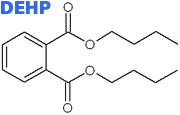
Phthalates are chemicals used to soften plastics. Recent studies have shown that the major source of human exposure to the two phthalates of most concern (DEHP and DBP) is through food. These phthalates are used primarily in polyvinyl chloride (PVC), so any steps in the processing, packaging, storage, or heating of food that use PVC-containing products can introduce them into the food chain.
How common is food storage in PVC containers? Just look in the kitchen of any restaurant. Everything is stored in these PVC container because they are compact, unbreakable, can be stacked and are easy to clean and re-use.
Swan hypothesized that phthalates may lower fetal testosterone production during a critical window of development -- somewhere within eight to 24 weeks gestation, when the testes begin to function -- thereby altering brain sexual differentiation.
To explore the question, researchers reconnected with mothers from the SFF sample and asked them to complete a standard research questionnaire, called the Preschool Activities Inventory (PSAI), for their children ages 3 1/2 to 6 1/2 years.
The PSAI is designed to discriminate play behavior within and between the sexes, and in the past has been shown to reflect the endocrine-disrupting properties of other toxins, such as PCBs and dioxins. The PSAI addressed three aspects of play: types of toys children choose (trucks versus dolls), activities (rough-and-tumble play, for example), and child characteristics.
The final survey scores are designed to reflect sex-typical play. Higher scores meant more male-typical play and lower scores meant more female-typical play.
Researchers then examined boys play-behavior scores in relation to the concentration of phthalate metabolites in their mothers' prenatal urine samples, finding that higher concentrations of DEHP and DBP metabolites were associated with less masculine play behavior scores.
Earlier studies by Swan and others have shown that phthalate exposure during pregnancy might affect the development of genitals of both male rodents and baby boys. Scientists refer to this cluster of genital alterations as the "phthalate syndrome," and research suggests that in rodent pups, the syndrome can have adverse consequences for later sexual development.
If endocrine disrupters such as phthalates can impair genital development and hormone levels in the body, the play-behavior study noted, then a deeper examination of how these chemicals impact the brain is warranted.
Previous studies about altered brain gender focused not on the reduction of hormones like testosterone, but of natural chemicals like androstendione that were produced by the mother and which blocked the receptors of the fetus from receiving testosterone. Androstendione is produced during periods of stress. It is theorized that this stress of the mother, during the first three months of pregnancy, could irreversably alter the brain gender of the fetus. Correlations have been found between maternal stress and homosexuality of their offspring.
This new study suggests that environmental toxins can also inhibit testosterone. But they do more than that. They strengthen the argument that homosexuality is not a chosen condition but a biological one.
Homosexuals continue to be discriminated against on every level in our society. The fundamental Christians condemn it as a "sin" and quote ancient Biblical passages which also called leprosy and epilepsy the work of the devil. This needs to change. More physicians and scientists must speak out and reveal the proof.
Or have we not come that far yet?
Common Plastics Chemicals Phthalates Linked to ADHD Symptoms
A new report by Korean scientists, published by Elsevier in the November 15th issue of Biological Psychiatry, adds to the potentially alarming findings about phthalates. They measured urine phthalate concentrations and evaluated symptoms of attention-deficit/hyperactivity disorder (ADHD) using teacher-reported symptoms and computerized tests that measured attention and impulsivity.
They found a significant positive association between phthalate exposure and ADHD, meaning that the higher the concentration of phthalate metabolites in the urine, the worse the ADHD symptoms and/or test scores.
Senior author Yun-Chul Hong, MD, PhD, explained that "these data represent the first documented association between phthalate exposure and ADHD symptoms in school-aged children." John Krystal, MD, the Editor of Biological Psychiatry, also commented: "This emerging link between phthalates and symptoms of ADHD raises the concern that accidental environmental exposure to phthalates may be contributing to behavioral and cognitive problems in children. This concern calls for more definitive research."
The U.S. Centers for Disease Control and Prevention, in the Summary of their 2005 Third National Report on Human Exposure to Environmental Chemicals, state that "very limited scientific information is available on potential human health effects of phthalates at levels" found in the U.S. population. Although this study was performed in a Korean population, their levels of exposure are likely comparable to a U.S. population.
The current findings do not prove that phthalate exposure caused ADHD symptoms. However, these initial findings provide a rationale for further research on this association.
| |
 The researchers used MRIs to determine the volume and shapes of the brains of 90 volunteers -- 25 straight and 20 gay members of each sex. They found that the straight men and gay women had asymmetrical brains; that is, the cerebrum (the largest part of the brain, which is responsible for thought, sensory processing, movement and planning) was larger on the right hemisphere of the brain than on the left. In contrast, they found that women and gay men had symmetrical cerebrums.