
Share:   |
You talkin' to me? ...
This was going to be an interesting story. Now it's interesting AND weird.
This article will take you through the examples and scientific understanding of Multiple Personality Disorders and contrast them with Spirit Possession and what we now know about Mind Control. It's something everyone really should know -- especially in these troubled times where rogue individuals often surprise and terrorize us with their unexplained acts.
What makes a person "explode" and do shocking acts of violence? How could this happen? What is it about their personality that instigates this dangerous behavior?
First, some background:
Personality is always a hot topic. Some of the most popular pages on viewzone.com (like the Color Preference Personality Test and Finger lengths reveal your hidden talents) discuss learning more about who we are -- our personality. Also popular are personality tests which confront us with a situation, an object or a color, then ask us to react to it. Our pattern of reaction discloses secret motives and hidden agendas which are based on statistical models.
When you think of it, that's weird. If we are our personality, why is it that we have to learn about ourselves in such remote ways? And who or what is doing the learning?
The answers to these questions are known. Understanding what is going on is your right to know. In fact you know already since you have a "self" so this information is just a reminder.
Identity usually comes with a name. Our family and friends associate our name with our physical being as well as an assortment of predictable behavior that forms our personality. Personality encompasses our posture, facial expressions, speech and vocabulary as well as an assortment of likes and dislikes. If we are sick or troubled, those close to us can often sense the subtle difference in our behavior and might ask, "Hey, are you OK?" In short, personality is who we are.
Although it is us, our personality can surprises us with strange behavior and previously unknown abilities. We have all done things which we later regret and which, even to us, seem out of character. At other times, we have all discovered talents and interests that have shaped the path of our lives.
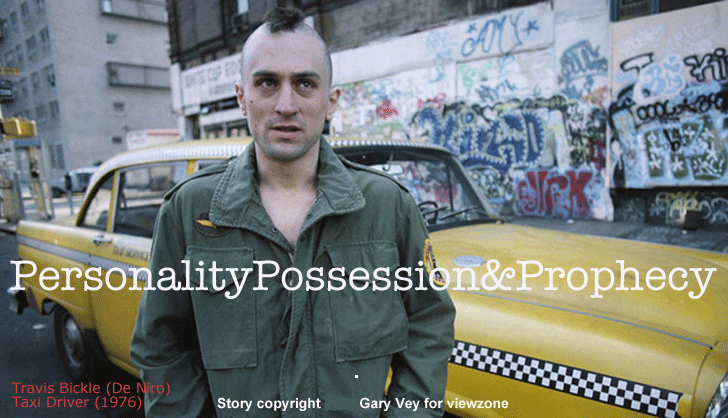
Like the violent "hero" that possessed Travis Bittle [top] in Taxi Driver, these things seem to "happen" to us -- it is almost as if personality has a life of its own. Actually, it's more than "almost as if".
In this article I will show that personality is a dynamic mental creation, and that it can be erased, turned on and off, be replaced, enhanced, repressed and terminated. You may never think of yourself (or others) the same again!
Multiple Personalities
When studying the origin and nature of personality, it helps to examine some extreme cases. The phenomenon of Multiple Personality Disorder presents the situation where the uniqueness of our identity is challenged, forcing us to re-evaluate the nature of "self".
Being "possessed" by spirits and demons is a known phenomenon in almost every culture. The general public first became aware of Multiple Personalities as a psychiatric condition in the 1957 film, The Three Faces of Eve:
In this classic film, based on a well known real case, Eve had two alternate personalities that emerged at different times. Each was unique and developed with their own vocabulary, accent and interests. The "normal" or host personality was unaware of the other alters, as they are called, and had no memory of their activity when they were "out".
But reality is even more bizarre. The average number of alters for a victim of multiple personalities is fifteen!
Psychologists have studied multiple personalities for the past several decades. What they have learned about this phenomenon has shattered our traditional concepts of "self" and, as you will see, has changed history.
|
First, some facts about alters
When we talk about alter personalities, we don't just mean that a person's emotions or attitudes have changed. Personality apparently goes much deeper.
Some alters efficiently use the opposite hand to write, draw or play games. Alters can have different allergies from their host -- even different eye glass prescriptions. Some alters have impressive musical talent or intellectual abilities which are lacking in other alters or the host personality. Some of the most interesting cases involve an adult with a child alter. When "out" the alter talks and acts like a child -- even drawing pictures like a child. Adult alters sometimes have their own name by which they are known to friends -- sometimes even families -- that are unaware of their other identities. Most of the time, the host is unaware of the alters and their activities. The alters, on the other hand, seem to share the experiences of the host and use this information to decide when it is adventageous to "come out." The host sometimes experiences a sign, such as a headache or tingling feeling, followed by complete amnesia. They can "wake up" hours or even years later. Early treatment for multiple personalities is usually for such things as headaches, depression, blackouts. Often the condition is misdiagnosed and confusing as different personalities reveal themselves through audio hallucinations. There is no spontaneous remission, yet some people learn to live with the various personalities by establishing a kind of co-operation. Here is a good example:
The youngest documented case of multiple personality disorder was 3 years old (Riley and Mead 1985) but the typical case presenting for help is a female adult, referred by friends or family for episodes of "unusual behavior". Some are self-referred because of "blackouts" or "depression." The young age (3 years) is quite a shocker and requires an explanation:
"The diagnostic features and treatment histories of 11 adolescents with multiple personality disorder (MPD) are presented. Clinical evaluation revealed that the majority of these adolescents manifested extremely variable school performance, disruptive behavior, trances, amnesias, mood swings, sharp changes in personality, apparent lying, voices heard in the head, and depression... These adolescents had a mean number of 24.1 alter personalities and appear to have become multiple at a mean age of 3 years, 1 month. So while the trigger for multiple personality can happen when we are very young, it usually becomes obvious later in life. Once the first personality is created, it apparently serves its purpose and the mind learns that this is an effective coping mechanism. What could be so stressful that a mind would go to this extreme?
|
The Common Denominator in MPD
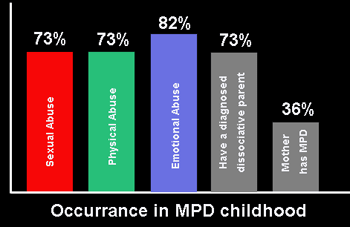
Almost all documented cases of MPD have a history of childhood trauma. In the study cited above, the trauma was categorized as follows: Sexual abuse (73%), physical abuse (73%), and emotional abuse (82%). Seventy-three percent had a parent with a diagnosable dissociative disorder; 36% of the mothers had MPD.
Recent statistics report that a third of all women in America report being molested or sexually abused as a child. One in five American women report that they have been raped [*] at least once in their life. It is possible that multiple personalities are more frequent, especially in females, than previously thought. These are so-called "covert" cases where the victim has learned to cope with the alter personalities.
A typical example of MPD (now called Dissociative Identity Disorder) is presented here:
"...A woman who had been physically and sexually abused by her father throughout her childhood and adolescence exhibited at least 4 personalities as an adult. Each personality was of a different age, representing the phases of the woman's experience -- a fearful child, a rebellious teenager, a protective adult, and the woman's primary personality. Only one of the personalities, the protective adult, was consciously aware of the others, and during therapy sessions was realized to have been developed to protect the woman during the abusive experiences.When one of the secondary personalities took over, it often led to episodic dissociative amnesia, during which the woman acted out according to the nature of the dominating personality. During intensive therapy sessions, each personality was called upon as necessary to facilitate their integration." -- [*]
One has to remember that the severity of the act or acts that trigger are relative to the victim's perceptions and feelings. Small things, like parental arguments or observed or experienced violence can make a child disassociate (i.e. withdraw) from reality.
The escape from physical or emotional pain may begin as daydreaming or fantasy and can develop in to an alter personality that either protects the host by emotionless cooperation or suicide. In this regard, some interesting characters re-appear in case studies.
Common Cast of Alter Characters
One way of understanding the various alters is to observe their emotional characteristics, since they were created as coping mechanisms. Interesting observation has been made by some therapists [*]. They have noted the following roles, which aptly describe common MPD alters:
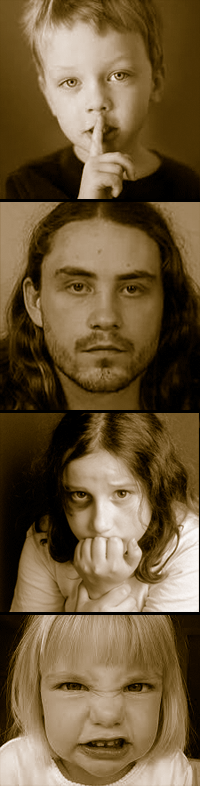
- Vulnerable Child -- The most sensitive and vulnerable feeling of abuse are sometimes confined to one personality, so that the others are spared the pain. This personality feels lonely, isolated, sad, misunderstood, unsupported, defective, deprived, overwhelmed, incompetent, doubts self, needy, helpless, hopeless, frightened, anxious, worried, victimized, worthless, unloved, unlovable, lost, directionless, fragile, weak, defeated, oppressed, powerless, left out, excluded, pessimistic.
- The Detached Protector -- This personality is meant to push others away. It cuts off needs and feelings; detaches emotionally from people and rejects their help; feels withdrawn, spacey, distracted, disconnected, depersonalized, empty or bored; pursues distracting, self-soothing, or self-stimulating activities in a compulsive way or to excess; may adopt a cynical, aloof or pessimistic stance to avoid investing in people or activities.
- The Angry & Impulsive Child -- This personality is as the name implies. It feels intensely angry, enraged, infuriated, frustrated, impatient because the core emotional (or physical) needs of the vulnerable child are not being met. It acts on non-core desires or impulses in a selfish or uncontrolled manner to get his or her own way and often has difficulty delaying short-term gratification; often feels intensely angry, enraged, infuriated, frustrated, impatient when these non-core desires or impulses cannot be met; may appear "spoiled".
- Compliant Surrenderer -- During sexual or physical abuse, it is sometimes safer for the victim to be compliant and avoid additional suffering. This personality acts in a passive, subservient, submissive, approval-seeking, or self-deprecating way around others out of fear of conflict or rejection; tolerates abuse and/or bad treatment; does not express healthy needs or desires to others; selects people or engages in other behavior that directly maintains the self-defeating schema-driven pattern.
- Overcompensator -- One way to feel good about yourself is to act as if you are successful. This personality feels and behaves in an inordinately grandiose, aggressive, dominant, competitive, arrogant, haughty, condescending, devaluing, overcontrolled, controlling, rebellious, manipulative, exploitative, attention-seeking, or status-seeking way. These feelings or behaviors must originally have developed to compensate for or gratify unmet basic emotional needs
- Punitive Parent -- If a child has been degraded and told repeatedly that he or she is worthless, this is the personality that believes it. It is deserving of punishment and blame. This can be a dangerous personality because it is prone to self-injury, like cutting and self-mutilation -- or even suicide. Occasionally this personality interacts with other people and this can result in the same harmful acts being committed on others.
- Demanding Parent -- A strict parent or abuser can be internalized in a personality that feels that the "right" way to be is to be perfect or achieve at a very high level, to keep everything in order. It is conservative in outlook and feels that it is wrong to express feelings or to act spontaneously. This personality puts a high importance on internalized high standards and strict rules. It occasionally berates other alters.
To some extent we all have these characters in our emotional repertoire. They are patterns that have worked successfully for us in the past and persist as part of our composite personality. But for people with multiple personalities, these characters are isolated from the host and have apparent consciousness of the host while they are passive (i.e. not "out").
I'll explain how this happens later. For now, let's move on to another extreme personality event.
While a person can have multiple personalities, it is also possible to lose one's identity. What remains is a curious memory of procedures and training. It's called fugue.
The "Fugue" of War

 Comments? || Body Mind Spirit

Taxi Driver: The Plot
Travis Bickle (Robert De Niro), an honorably discharged U.S. Marine, is a lonely and depressed man living in Manhattan, New York. He becomes a taxi driver in order to cope with chronic insomnia, driving passengers every night around the boroughs of New York City. He also spends time in seedy porn theaters and keeps a diary.
Travis becomes infatuated with Betsy (Cybill Shepherd), a campaign volunteer for Senator Charles Palantine (Leonard Harris), who is running for President. After watching her through her office window, interacting with fellow worker Tom (Albert Brooks), Travis enters to volunteer as a pretext to talk to her and takes her out for coffee. On a later date he takes her to see a sex film, which offends her, so she goes home alone. His attempts at reconciliation by sending flowers are rebuffed so he berates her at the campaign office, before being kicked out by Tom.
Travis confides in fellow taxi driver Wizard (Peter Boyle) about his thoughts, which are beginning to turn violent, but Wizard assures him that he will be fine.
Disgusted by the street crime and prostitution that he witnesses through the city, Travis finds a focus for his frustration and begins a program of intense physical training. He buys guns from dealer Easy Andy (Steven Prince) and constructs a sleeve gun to attach on his arm with which he practices drawing his weapons.
Looking in the mirror, Travis cocks his head as if responding to intimidation. "You talkin' to me?" He repeats this phrase several times and it has become one of the most memorable lines of the entire movie.
One night, Travis enters a convenience store moments before a man attempts to rob it and shoots the robber. The shop owner (Victor Argo) takes responsibility and Travis leaves. On another night, 12-year-old child prostitute Iris (Jodie Foster) enters Travis's cab, attempting to escape her pimp Matthew "Sport" (Harvey Keitel). Sport drags Iris from the cab and throws Travis a crumpled twenty-dollar bill, which continually reminds him of her.
Travis arranges to meet Iris and attempts to persuade her to quit prostitution. They meet again the next day for breakfast and Travis becomes obsessed with helping her return to her parents' home, sending her money to do so and a letter in which he states he will soon be dead.
After shaving his head into a mohawk, Travis attends a public rally where he attempts to assassinate Senator Palantine, but Secret Service agents notice him and he flees without taking a shot. He returns to his apartment and then drives to the East Village, where he confronts Sport. Travis shoots him, then walks into Iris' brothel and shoots off the bouncer's fingers. After Sport shoots Travis in the neck, wounding him, Travis shoots him dead.
Another thug appears and shoots Travis in the arm, but Travis reveals his sleeve gun and kills the thug. The bouncer continues to harass Travis, causing Travis to shoot him in the head and kill him. As a horrified Iris cries, Travis attempts suicide but, out of ammunition, resigns himself to a sofa until police arrive. When they do, he places his index finger against his temple gesturing the act of shooting himself.
Recuperating, Travis receives a letter from Iris's parents who thank him for saving her and the media hail him as a hero. Travis then returns to his job and encounters Betsy as a fare. She discusses his newly found fame, but he denies being a hero and drops her off free of charge. He glances anxiously at her in his rear view mirror as he drives away.
John Hinckley, Jr.
Taxi Driver formed part of the delusional fantasy of John Hinckley, Jr. which triggered his attempted assassination of President Ronald Reagan in 1981, an act for which he was found not guilty by reason of insanity. Hinckley stated that his actions were an attempt to impress actress Jodie Foster, on whom Hinckley was fixated, by mimicking Travis's mohawked appearance at the Palantine rally. His attorney concluded his defense by playing the movie for the jury.